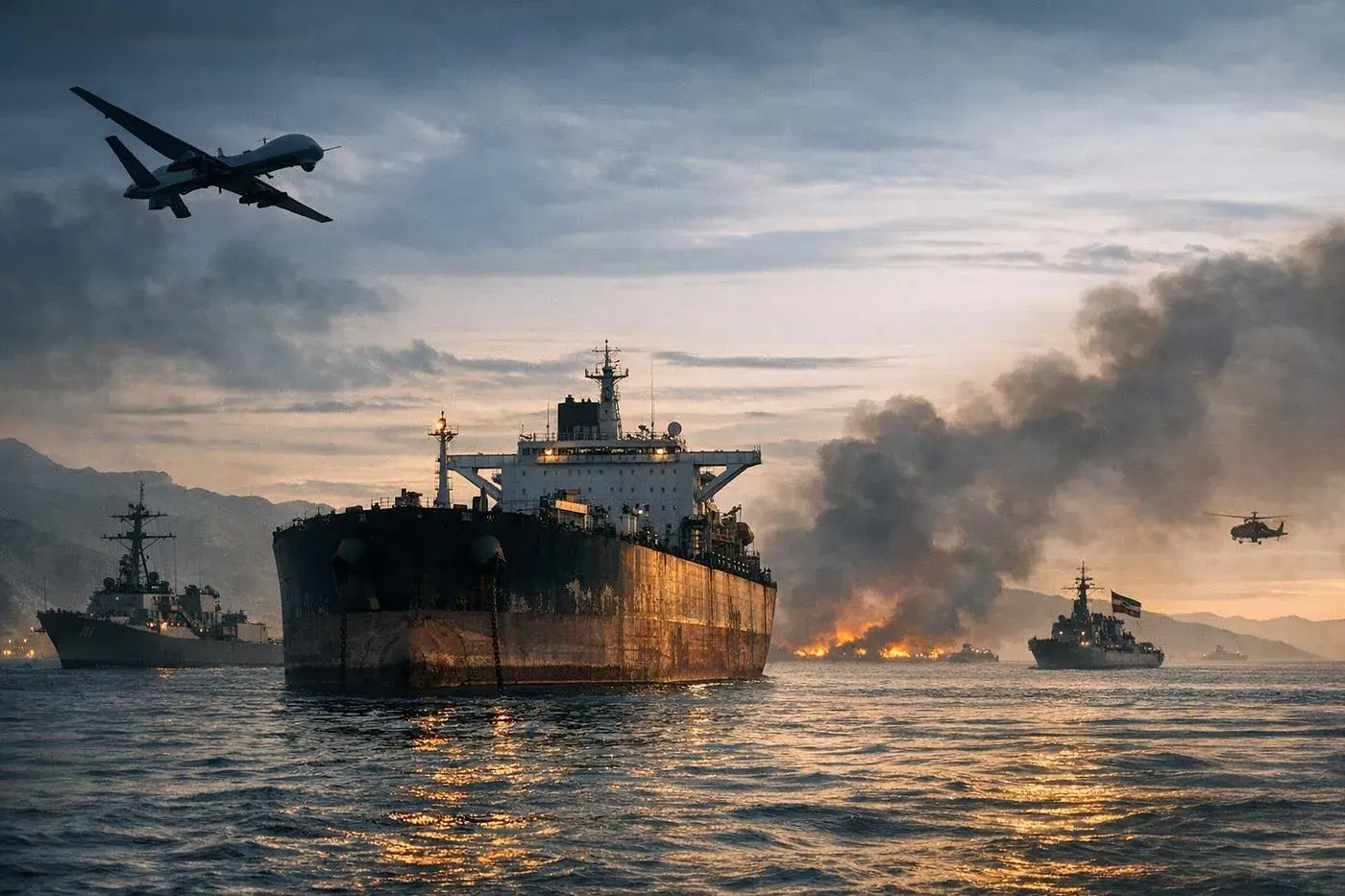
The Strait of Hormuz has been the world's most dangerous maritime chokepoint for decades. But in recent weeks, the temperature around this narrow waterway has risen to levels not seen since the Gulf Wars. The catalyst isn't a new Iranian missile test or another tanker seizure — it's something far more calculated: "Project Freedom," President Trump's initiative to escort commercial shipping through waters that Iran considers its strategic backyard.
What makes this moment particularly treacherous for markets is the sequence of events that followed the announcement. Saudi Arabia and Kuwait — traditionally reliable American allies in the region — initially restricted US military access to their airspace and bases. Then, almost as quickly, those restrictions were lifted. The whiplash sent crude oil on a roller coaster that traders are still trying to decode.
When "Project Freedom" was first announced, Brent crude spiked to $125 per barrel. After diplomatic signals suggested a deal might be near, it collapsed to $96-97. Now, with access restrictions lifted and renewed uncertainty, it's trading around $110. Each $10 move in crude translates to billions in inflation expectations, rate-cut probabilities, and equity market sentiment.
Project Freedom: Escalation Disguised as Commerce
Trump's framing of the initiative is deceptively benign: American ships need safe passage, so America will provide escorts. But the Iranian read is starkly different. From Tehran's perspective, foreign military vessels operating in the Persian Gulf under the banner of "freedom of navigation" is an act of indirect warfare — especially when those same vessels previously engaged in direct military exchanges.
The recent naval clash between US and Iranian forces in the Gulf illustrates how quickly "escort missions" become shooting wars. Both sides exchanged fire. Both sides suffered damage. Trump downplayed it as "a small flare-up, like a love tap," insisting that the ceasefire remains intact and that Iran has essentially agreed to abandon its nuclear ambitions. But the Iranian response tells a different story entirely.
Iran's Counter-Narrative: Missiles, Not Diplomacy
While Trump claims victory and imminent nuclear deals, Iranian leadership — including the Foreign Minister and Parliament Speaker — has been issuing statements that range from skeptical to openly hostile. They've rebranded "Project Freedom" as "Project Disaster" and "Project Deadlock." The mocking tone isn't diplomatic posturing; it's a signal that no deal is forthcoming.
The most alarming development came after market close, when Iran's Foreign Minister posted a direct message aimed at Trump. The core message: Iran's missile stockpiles are not depleted — they're 120% of pre-war levels compared to February 28. The Iranian people are "1000% ready" to defend. And perhaps most pointedly: "Don't underestimate us. Don't pick unnecessary fights."
The Saudi-Kuwait Reversal: Reading Between the Lines
The initial restriction of US base access by Saudi Arabia and Kuwait was a significant diplomatic signal. These are nations that have hosted American military infrastructure for generations. Their hesitation suggested genuine fear that "Project Freedom" would trigger Iranian retaliation against Gulf targets — not just American ones.
The subsequent lifting of those restrictions is equally telling. It suggests either: (a) back-channel assurances were given that the operation would remain limited, or (b) pressure was applied that Gulf states couldn't resist. Either way, the green light for "Project Freedom" is back on — and crude markets are pricing renewed geopolitical risk accordingly.
Crude Oil: The Canary in the Coal Mine
If "Project Freedom" proceeds and Iran retaliates meaningfully, crude oil becomes the primary transmission mechanism for geopolitical risk into financial markets. A sustained move above $125-130 per barrel would trigger:
- Inflation repricing: Energy costs feed directly into CPI calculations, potentially derailing rate-cut expectations
- Margin compression: Transport, logistics, and manufacturing sectors face immediate cost pressure
- Currency volatility: Oil-importing nations see trade deficits widen, pressuring exchange rates
- Equity rotation: Energy sectors outperform while consumer discretionary and industrials underperform
Trump's Legal and Political Constraints
Adding another layer of complexity, US courts have recently ruled against Trump's tariff authority. Section 122 tariffs were deemed illegal, and additional tariff escalations have been blocked. This judicial pushback limits the administration's economic leverage and may increase the temptation to use military brinkmanship as a negotiating tool.
The combination of constrained tariff options, an unresolved Iran nuclear file, and a president who describes naval exchanges as "love taps" creates an environment where miscalculation is not just possible — it's probable.
Positioning for Uncertainty
For investors, the playbook is clear: expect volatility, but don't panic. Markets have demonstrated remarkable resilience through April and early May, with the Nifty recovering 10%, mid-caps 18%, and small-caps 23% from their lows. This recovery happened despite — not because of — geopolitical headlines.
The key is mental preparation. If "Project Freedom" escalates and crude spikes, the initial market reaction will likely be sharp and scary. But the structural recovery dynamics remain intact. The question isn't whether volatility arrives — it's whether your portfolio is positioned to absorb it without forced liquidations at the worst possible moments.