What Did PM Modi Say? Decoding the Government's Economic Warning in May 2026
What Did PM Modi Say? Decoding the Government's Economic Warning in May 2026
Prime Minister Modi's recent statements on economic caution have drawn significant attention from markets and industry. Here's what was actually said and what it means.
📋 What's Inside
- What Modi Actually Said
- Context of the Warning
- Market Reaction
- Sectors Potentially Impacted
- Government's Fiscal Roadmap
What Modi Actually Said
In a recent address to industry leaders and at a public forum, Prime Minister Narendra Modi delivered a strong message on economic discipline and global preparedness. While the exact transcript varies across sources, key themes from his statements included:
"The world is going through uncertain times. India must prepare for all scenarios. Fiscal prudence is not optional — it is essential for long-term stability."
Key Messages from the PM's Address:
- Fiscal Discipline: The government will prioritize maintaining the fiscal deficit target of 4.5% of GDP for FY27, even if it means slower growth in certain welfare schemes.
- Global Uncertainty: Modi explicitly referenced geopolitical tensions — particularly the US-Iran conflict — and warned that India must be prepared for commodity price shocks and supply chain disruptions.
- Regulatory Crackdown on Speculation: The PM endorsed SEBI's recent tightening of F&O norms, stating that speculative excesses in the derivatives market pose systemic risks to retail investors.
- Caution on Debt: A subtle warning to states and corporations to avoid excessive leverage, drawing parallels to past financial crises triggered by debt bubbles.
- Atmanirbhar Push: Reiterated the focus on domestic manufacturing and reducing import dependence, especially in energy and critical minerals.
Context of the Warning
This wasn't a routine speech. The timing matters:
Timing
Pre-Budget Signal
FY27 budget due in July 2026
Global Context
US-Iran War Risk
Oil prices spiking, FII outflows
Domestic Context
Election Year Done
No more populist pressure till 2029
Market Context
Valuation Concerns
Nifty at 24x forward PE
Analysts interpret this as the government signaling a shift from "growth at all costs" to "sustainable and inclusive growth." With the 2024 general elections behind and no major state elections immediately ahead, the government has political room to push unpopular but necessary fiscal measures.
Market Reaction
The markets reacted swiftly to Modi's comments:
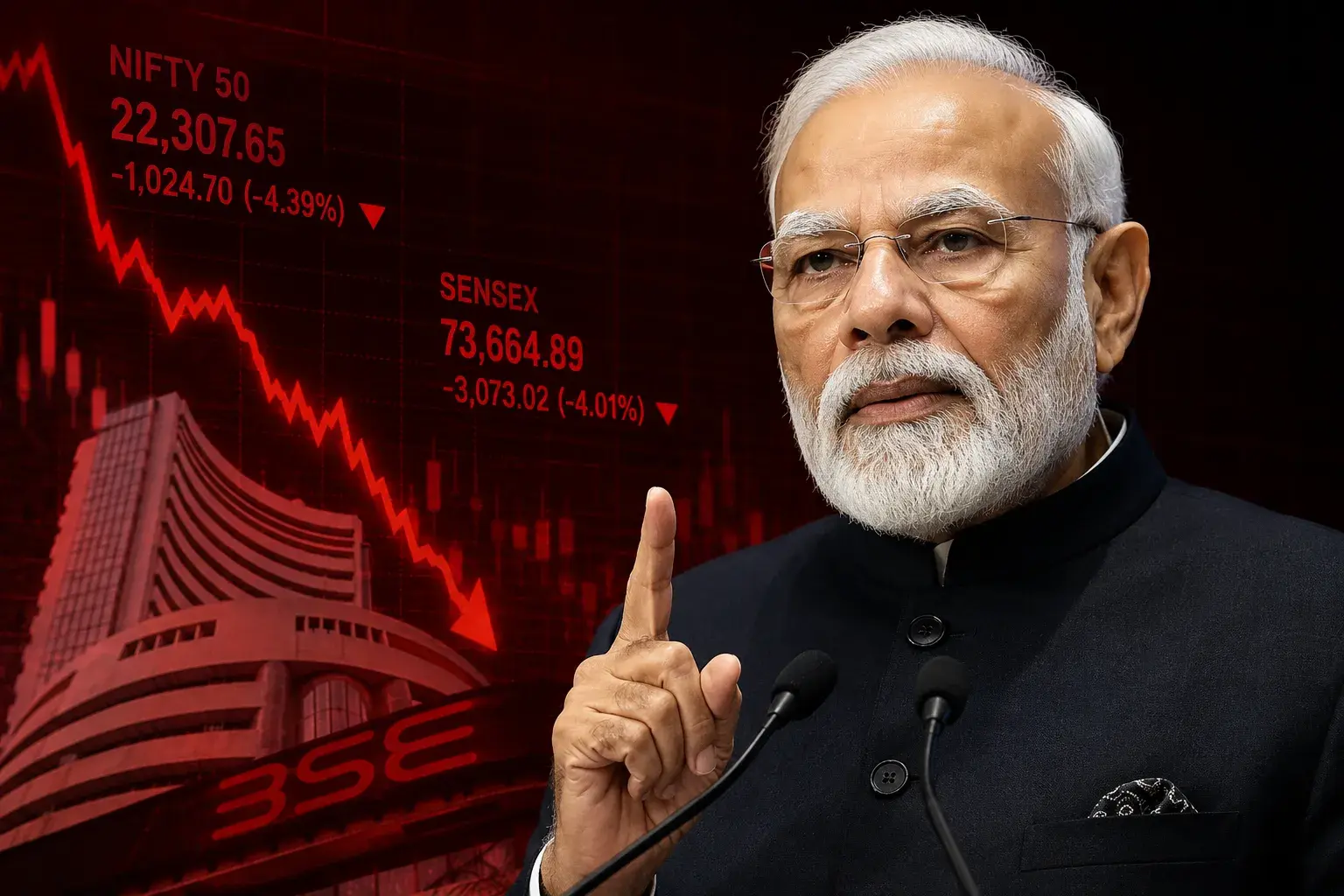
- Nifty Correction: The Nifty 50 dropped approximately 1.8% in the two trading sessions following the speech, with real estate and consumer discretionary stocks leading the decline.
- FII Acceleration: Foreign investors, already net sellers in May, intensified outflows as the fiscal discipline message was interpreted as potentially lower government capex.
- Bond Market Rally: Surprisingly, government bond yields softened by 5-7 basis points as investors priced in lower borrowing requirements.
- Rupee Stability: The INR held steady around 86.5/USD, as fiscal prudence signals improved India's sovereign risk profile.
Analyst View: Most brokerages view this as a net positive for India's long-term creditworthiness, even if it creates short-term volatility in equity markets. Moody's and S&P have both cited India's fiscal consolidation as a key factor in maintaining its investment-grade sovereign rating.
Sectors Potentially Impacted
Sectors That May Face Headwinds:
- Real Estate: Tighter liquidity and reduced government affordable housing subsidies could slow sales momentum in tier-2 and tier-3 cities.
- Discretionary Consumption: With the government signaling fiscal restraint, rural demand schemes (like PM-KISAN enhancements) may see slower expansion, impacting FMCG and consumer durable companies.
- Infrastructure (Private): PPP projects dependent on government guarantees or viability gap funding may face delays.
- F&O Brokers: SEBI's margin hike and potential additional restrictions on derivatives trading could compress broker revenues.
Sectors That Could Benefit:
- PSU Banks: Lower government borrowing means less crowding out in the bond market, potentially improving credit availability.
- Defence: The Atmanirbhar push and ongoing geopolitical tensions suggest continued strong allocation to domestic defence manufacturing.
- Export-Oriented Pharma: A stable rupee and focus on reducing import dependence could benefit domestic API manufacturers.
- Renewable Energy: Energy independence remains a priority, with solar and wind likely to see sustained policy support.
Government's Fiscal Roadmap
Based on the PM's statements and recent Ministry of Finance communications, here's what the fiscal roadmap looks like:
FY27 Fiscal Deficit Target
4.5% of GDP
Down from 4.8% in FY26
Government Capex Growth
~10% YoY
Slower than previous years' 25%+
Subsidy Bill
Contained
Focus on direct benefit transfer efficiency
Disinvestment Target
₹50,000 Cr
Modest but realistic
Bottom Line: PM Modi's warning is essentially a reality check. The government is choosing long-term macroeconomic stability over short-term market euphoria. For investors, this means expecting lower but more sustainable returns, with quality companies (strong balance sheets, domestic revenue focus) likely to outperform leveraged or government-dependent businesses.
Last updated: