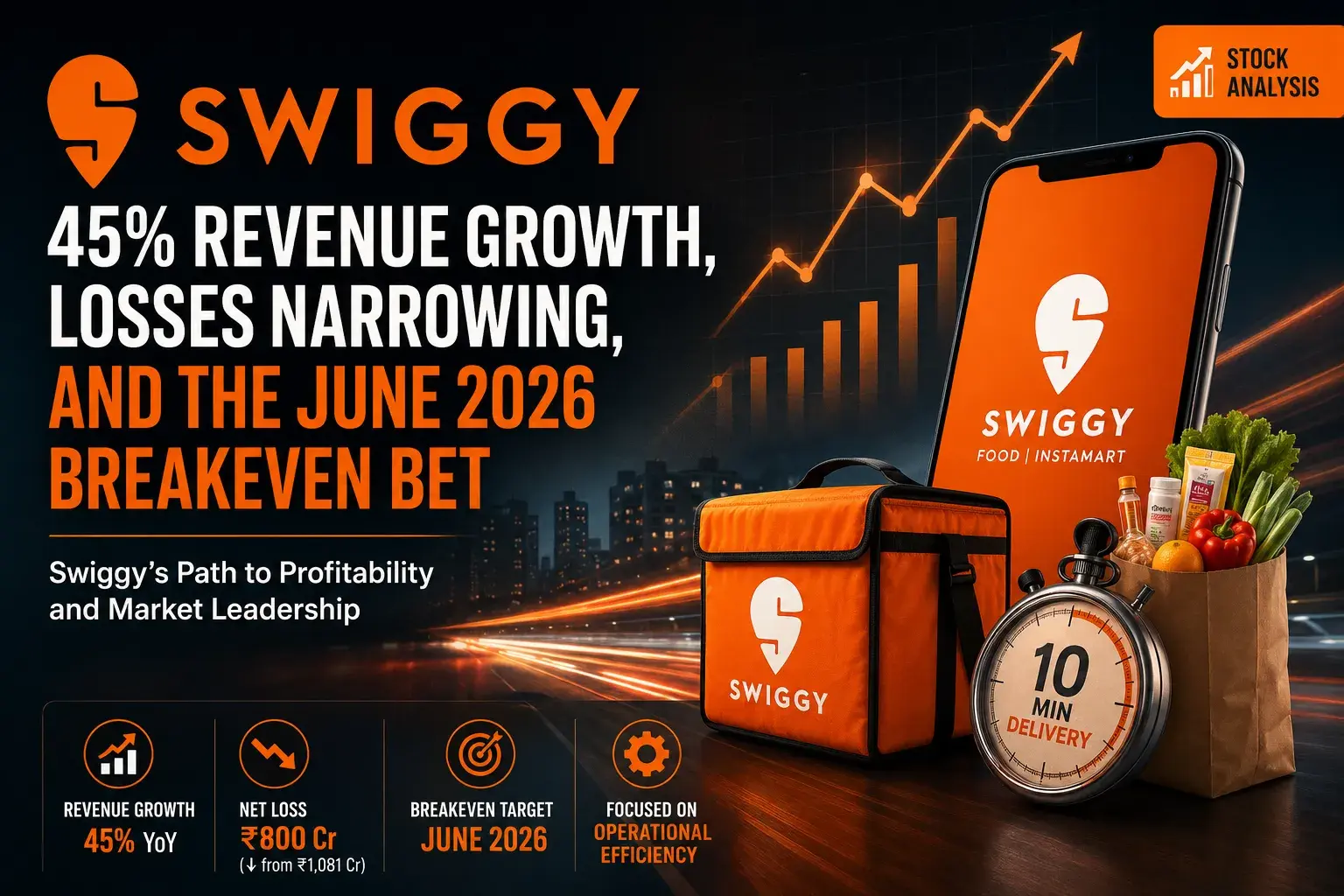
Swiggy's latest quarterly numbers tell a story of disciplined growth management in a sector notorious for cash incineration. Revenue surged 45% year-on-year, but the headline that matters most is the net loss narrowing to ₹800 crore from ₹1,081 crore in the same quarter last year. This isn't profitability — it's progress toward profitability, and in the food delivery wars, progress is rare enough to merit attention.
From ₹1,081 crore loss to ₹800 crore loss while growing revenue 45% — this is the operational leverage that food delivery bulls have been waiting for. Swiggy is demonstrating that scale can indeed reduce unit losses, even in a business model where every order historically bled money.
Food & Grocery: The Core Engine
The food and grocery delivery platform delivered 45% growth through operational improvements rather than reckless discounting. This distinction matters enormously. Previous growth spurts in food delivery were fueled by customer acquisition subsidies that destroyed unit economics. Swiggy's current growth appears more organic — driven by habit formation, menu expansion, and delivery density rather than coupon codes.
Management's guidance is particularly noteworthy: contribution margin breakeven is targeted for June 2026. This is a specific, time-bound commitment that creates accountability. If Swiggy hits this target, the investment narrative shifts from "can they survive?" to "how much can they earn?" — a transition that typically drives significant multiple expansion.
Quick Commerce: The Next Battleground
Swiggy's Instamart quick commerce vertical is the strategic priority that keeps management awake at night. The 10-minute delivery promise requires dark stores, inventory risk, and complex supply chain management — capabilities that are very different from the asset-light restaurant marketplace model that built Swiggy. The capital intensity is higher, the failure modes are more numerous, and the competitive pressure from Blinkit and Zepto is relentless.
The quarterly numbers suggest Swiggy is being selective about quick commerce expansion rather than blitzscaling. Dark store additions were measured, and the focus appears to be on improving existing store economics rather than geographic carpet-bombing. This restraint is either prudent capital allocation or competitive capitulation — the distinction will become clear over the next two quarters.
Blinkit Comparison: Similar Numbers, Different Narratives
The transcript draws a direct comparison between Swiggy and Blinkit (Zomato's quick commerce arm), and the similarities are striking. Both show gross order value that's essentially flat quarter-on-quarter. Both are prioritizing contribution margin improvement over growth acceleration. Both have added dark stores selectively — Blinkit around seven stores in the latest quarter. The convergence suggests the quick commerce sector is entering a phase of rationalization after the initial land grab.
For investors, this convergence is positive. A duopoly that competes on service quality rather than discounting is infinitely preferable to a price war that destroys capital for all participants. The risk is that either player breaks ranks and reignites promotional spending to gain share.
Contribution Margin: The Metric That Matters
Contribution margin — revenue minus variable costs per order — is the North Star metric for food delivery economics. Swiggy's quarter-on-quarter improvement in this metric, even as growth decelerated, indicates that the business is becoming structurally more efficient. Delivery times are improving, restaurant commissions are stabilizing, and customer retention is reducing the need for expensive reactivation campaigns.
The June 2026 breakeven target depends on continued contribution margin expansion. If Swiggy can deliver 5-7% contribution margins consistently, the fixed cost base becomes manageable and operating leverage kicks in. If contribution margins stagnate, breakeven slips and investor patience frays further.
Technical Outlook: Bottoming Formation
Swiggy's stock has been in a brutal downtrend since listing, with each rally sold into aggressively. The recent price action, however, shows signs of stabilization. Volume patterns suggest distribution is giving way to accumulation, and the earnings reaction — while negative — didn't break key support levels. For contrarian investors, this is the type of setup that often precedes significant reversals.
The risk is that "bottoming" can persist for months, testing the patience of even the most committed value investors. Without a clear catalyst — profitability announcement, strategic partnership, or regulatory development — the stock may simply drift sideways in a wide range.
Risk Factors
- Breakeven delay: If June 2026 target is missed, the stock will face severe re-rating
- Competitive re-escalation: Blinkit or Zepto could restart discount wars, forcing Swiggy to respond
- Regulatory risk: Delivery worker classification, commission caps, or data privacy rules could impact economics
- Funding requirements: Current cash may not be sufficient to reach breakeven without additional capital
Future Outlook
Swiggy is transitioning from a growth-at-all-costs startup to a disciplined operation focused on unit economics. This transition is painful, slow, and often unpopular with growth-oriented investors. But it's the only path to sustainable value creation in a business where previous models have destroyed billions in capital.
For investors with 18-24 month horizons, Swiggy represents a high-risk, high-reward bet on Indian food delivery consolidation. The stock is inappropriate for conservative portfolios but may deliver exceptional returns if the breakeven thesis plays out as management projects. The key is position sizing: small enough that a total loss doesn't impair portfolio performance, large enough that a 3-5x return moves the needle.