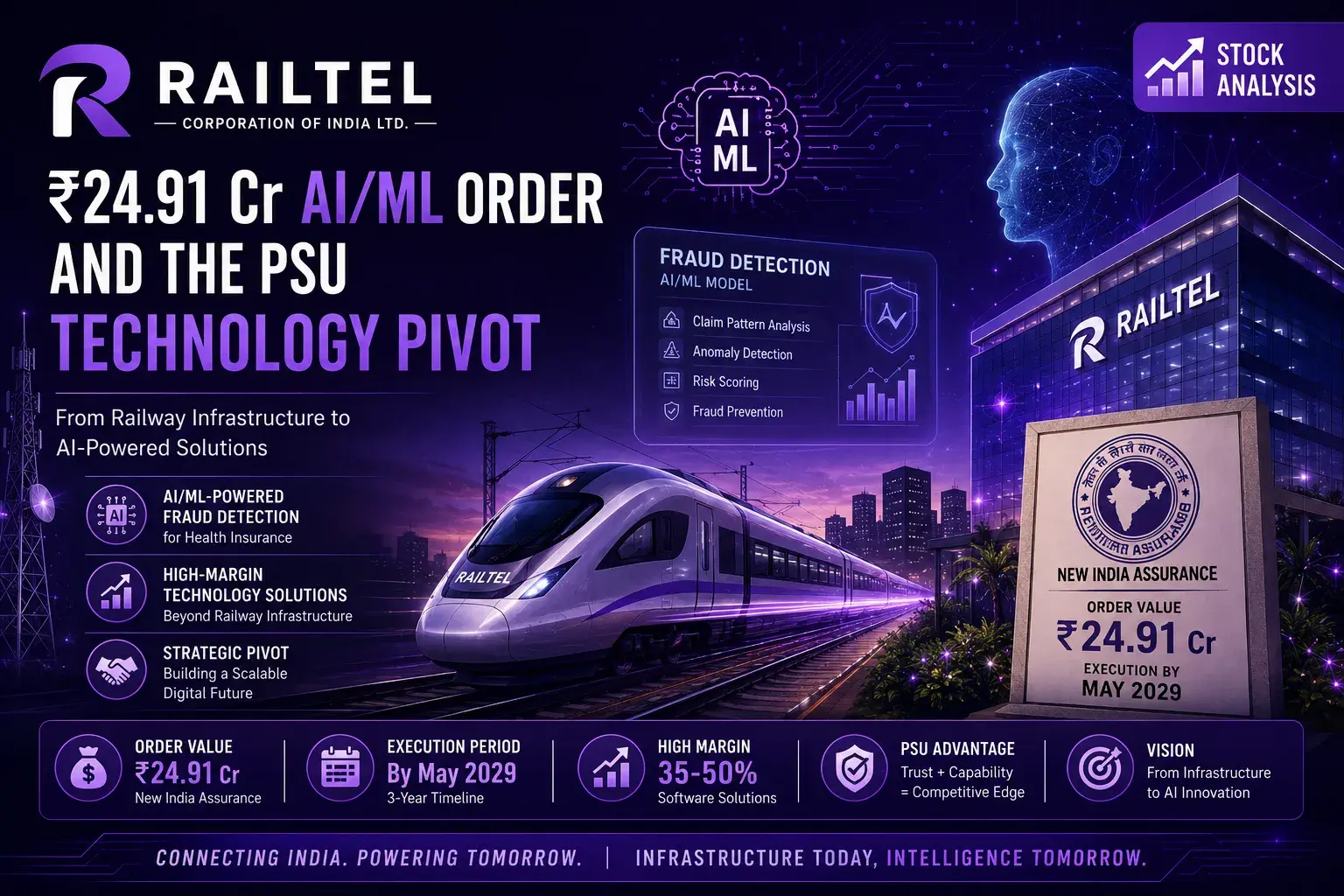
RailTel has secured a landmark order that signals its evolution from a traditional railway infrastructure provider to a cutting-edge technology solutions company. The ₹24.91 crore contract for Artificial Intelligence and Machine Learning-based Health Insurance Fraud Detection — awarded by New India Assurance — represents a strategic pivot that could redefine how the market values this erstwhile "railway stock."
A ₹24.91 crore order from New India Assurance for AI/ML-powered health insurance fraud detection, to be executed by May 2029. This isn't maintenance work or fiber laying — it's sophisticated algorithm development that commands premium margins and creates referenceable credentials for future fintech and insurance sector bids.
Beyond Railways: The Diversification Imperative
For decades, RailTel was pigeonholed as a railway communications infrastructure play — fiber optics along tracks, signaling systems, and telecom towers. While this core business provides stable, government-backed revenue, it also caps valuation multiples because infrastructure services are capital-intensive and margin-constrained. The AI/ML order represents a deliberate strategy to escape this valuation trap.
Health insurance fraud detection is a high-growth, high-margin vertical where Indian insurers are massively underinvested in technology. Estimates suggest fraud accounts for 10-15% of health insurance claims — a ₹3,000+ crore annual leakage that AI systems can materially reduce. RailTel's entry into this space, backed by a marquee client like New India Assurance, positions it for follow-on contracts across the insurance ecosystem.
Margin Implications: Software vs. Infrastructure
The critical investment consideration is margin structure. Railway infrastructure projects typically operate at 12-18% EBITDA margins with heavy upfront capital requirements. Software and AI solutions, by contrast, can deliver 35-50% margins with minimal incremental capex once the development platform is built. If RailTel can transition even 20% of its revenue mix toward software solutions, the blended margin profile improves dramatically.
The fraud detection order is a proof point, not a transformation. To genuinely rerate, RailTel needs a pipeline of similar technology contracts across insurance, banking, and government verticals. The 2029 execution timeline provides four years to build this pipeline — ample time if management maintains focus, but also ample time for execution drift if the core railway business demands attention.
Railway Core: Stable but Not Exciting
RailTel's traditional business isn't broken — it's just fully valued. The Indian Railways modernization program continues to generate steady order flow for fiber deployment, Wi-Fi connectivity, and digital signaling. These projects provide predictable cash flows that fund the technology diversification without requiring external capital.
The risk is that railway capex cycles are politically sensitive and fiscally constrained. Any slowdown in Indian Railways' capital allocation would directly impact RailTel's core revenue. The technology diversification is partly a hedge against this cyclicality, but the hedge only works if the new verticals scale fast enough to offset any core decline.
Competitive Positioning: First-Mover in PSU Tech
Among public sector undertakings, RailTel is unusually positioned to capture technology outsourcing contracts. It has the government credibility that private sector vendors sometimes lack, combined with technical capabilities that traditional PSUs rarely possess. This hybrid identity — trustworthy enough for government contracts, competent enough for technology work — is a genuine competitive advantage in India's digitization push.
The New India Assurance contract validates this positioning. If RailTel can replicate this success with other public sector insurers (United India, Oriental Insurance, National Insurance), the addressable market expands significantly. And if it can eventually target private insurers, the margin potential increases further.
Technical Outlook: Breakout Potential
RailTel's stock has been consolidating in a range that reflects investor uncertainty about the company's strategic direction. The AI/ML order provides a catalyst that could break this consolidation to the upside. Volume patterns on the announcement suggest genuine institutional interest rather than retail speculation.
For traders, a sustained move above recent resistance with volume confirmation would signal a new uptrend. For investors, the question is whether current prices adequately discount both the core railway business stability and the technology optionality. The answer likely depends on how aggressively management pursues additional software contracts in coming quarters.
Risk Factors
- Execution risk: AI/ML projects are complex; any delay or quality shortfall would damage credibility
- Core business dependence: Railway revenue still dominates; technology diversification is nascent
- Competition: Private sector IT vendors (TCS, Infosys, WNS) may target the same fraud detection market
- PSU constraints: Talent acquisition, compensation structures, and decision-making speed may limit agility
Future Outlook
RailTel is at an inflection point that many PSU stocks never reach: the opportunity to transcend its legacy business and enter higher-margin, faster-growing markets. The AI/ML fraud detection contract is the first concrete step in this journey. Whether it becomes a genuine transformation or merely a one-off order depends entirely on management's execution discipline over the next 18-24 months.
For investors, RailTel offers a rare combination in the PSU space: downside protection from the core railway business and upside optionality from technology diversification. The stock isn't a momentum play; it's a patience play. But for portfolios that can afford to wait, the risk-reward is increasingly attractive.